9.30.2014

Leapfrog From Disaster Symposium will radically generate and seed distinctive solutions to the challenge of today’s natural hazards

0 comments
Chicago, IL. — More people are now living in natural disaster-prone areas resulting from climate change. In 2013, over 22 million people were displaced by natural disasters, as reported and backed by the UN in the Norwegian Refugee Council’s Internal Displacement Monitoring Center (IDMC) Global Estimates. That year, category 5 Super Typhoon Haiyan in the Philippines displaced 4.1 million people alone — a million more than the combined effects experienced in Africa, the Americas, Europe, and Oceania.

Organized and led by the Royal Institute of British Architects (RIBA)-USA and Leapfrog Project including the American Institute of Architects’ AIA NY Design for Risk and Reconstruction (DfRR) and AIA International, “Leapfrog From Disaster” will be held in the Philippines on November 1 – 7, 2014 to bring together world-leading pioneers in Resilience, Architecture, and Ecology.

“Leapfrog Project’s role and potential for the Philippines is staked out, and a unique role for (Filipino) architects defined. (This) symposium will be hugely important as the one year anniversary of the disaster (Haiyan/Yolanda) approaches,” said USA Ambassador (ret) John F. Maisto, President of the US-Philippines Society.

Speakers, which include influencers in science, business, government, and the arts, as well as the delegates, will be challenged to re-invent the post-disaster paradigm, going beyond current aspirations and expectations in post-disaster rehabilitation.

“Typhoon Haiyan/Yolanda was very devastating and horrible. Having witnessed its impacts firsthand and assisted in rebuilding, I saw the tremendous amount of work going on including all the help that’s happening around the world. I’m delighted to hear of the efforts being made toward this symposium. It sounds super special, positive, innovative, and I hope it will go a long way,” shared Billy Dec, The Whitehouse, US President’s Advisory Commission on Asian Americans and Pacific Islanders (AAPI).

"It is truly an honor to be with individuals who are willing to share their resources to help rebuild our nation,” said confirmed speaker and Philippine TV personality/Trainstation CEO Carelle Mangaliag. “In this Symposium, I also get to work with an inspired new organization such as the Leapfrog Project, at the heart of building a resilient future for Philippines. Thankful for this opportunity to serve,” further comments this Rappler.com content producer.

Ultimately the Symposium aims to: Organize a genuinely collaborative post-disaster rebuilding initiative that utilizes wide-ranging local, national and international expertise, efforts, and resources to help Tacloban and its neighboring cities rebuild with resilience; Engage different schools of thought from design, science, technology and business, through interdisciplinary discourse and group activities both during and after the symposium; Birth a new school of architecture-and-design-thinking from the typhoon rebuilding efforts, which may inform future natural hazard resilience programs worldwide; Develop ecologically-friendly architectural solutions that help protect the rich biodiversity of the region and beyond.


About Leapfrog Project

Leapfrog Project was officially launched during the 2014 American Institute of Architects (AIA) National Convention and is now deployed to respond to the call of rebuilding. It is a project under the Orem Foundation, a US registered 501(c)(3) tax exempt Non-Profit Corporation.  It rallies a number of local and international partners to collaborate in helping Tacloban and its neighbouring cities rebuild with resilience, to serve as model of post-disaster reconstruction to the rest of the country and perhaps, the world.
Read full post »

7.08.2014

....... No matter who you are, what you look like, where you're from, or who you love, you were the 'IN' crowd

0 comments
The first-ever Global Inclusion Reception (EV321) of the American Institute of Architects (AIA) was held during its national convention in Chicago on June 27, 2014 at the Hafele Chicago Showroom. Here are my three takeaways from the event:
  1. It is possible for a diverse group of creative organizations to come together in fellowship.
  2. Humanitarian issues, like the most recent need for rebuilding after category 5 typhoon Haiyan (Yolanda), are global operations that require a spirit of communal unity, because no one is exempt from experiencing natural disasters.
  3. "No matter who you are, what you look like, where you're from, or who you love," architecture and design can be a profession where you are part of the 'IN' crowd.
Members of the US Whitehouse delivered enlightening and inspiring messages about diversity and inclusion, from Billy Dec who's a Presidential-Appointee to the Whitehouse Asian-American and Pacific Islanders (AAPI), to US Ambassador John Maisto...   US Ambassador John Maisto (ret) "A really great talk too Billy Dec. Inspirational -Diversity Rocks," shares Immediate Past President of the Royal Institute of British Architects (RIBA), Angela Brady PPRIBA FRIAI FRIAS FRSA FAIA FRIAC BIID Ph.D, who was in attendance. She further mentions after meeting Ambassador Maisto at the event, "It was a pleasure meeting such an enlightened man on great humanitarian issues." It was a showcase of diversity in all of its forms where official partners of the AIA Diversity and Inclusion came together for an evening of fellowship. The evening's programmed presentations were woven together by Master of Ceremonies, Kyle Hillman, that started with... AIA Diversity Council (Co-Chair): Wendy Ornelas, FAIA NOMA (National President): Kathy Dixon AIA, NOMA, LEED AP, NCARB Arquitectos (immediate Past-President): Juan Gabriel Moreno, AIA[/caption] Other multicultural professional organizations participated in celebration of diversity... Royal Institute of British Architects (RIBA)-USA (President): James Karl Fischer RIBA, AIA, PhD American Society of Interior Designers (CEO): Randy W. Fiser LA.IDEA | DC (Co-Chair): Jeannette (Gigi) Soto
LA.IDEA | DC: Juan Carlos Alvarez Tiffany C. Millner, AIA, NOMA from the AIA Diversity Council board shared the 40th Anniversary exhibit of Chicago Women in Architecture in the Chicago Architecture Foundation.[/caption] Members of the LGBT community as well as another official partner of the AIA Diversity and Inclusion, Out & Equal, transformed the Hafele showroom using multimedia and ambience that made the evening magical. Multimedia Installations by Troy Larsen[/caption] Which quickly became a hit and encouraged interaction among guests. Guests interacting with the installations.[/caption] And lastly, the celebration had a humanitarian component. Led by collaborators from the Leapfrog Project, there was a silent auction and raffle to benefit the rebuilding efforts in the Philippines after its central cities were decimated by category 5 typhoon Haiyan (Yolanda). Leapfrog Project Collaborators Melissa Sterry (Design Scientist) and Enrique Otarola (Orem Foundation) announce the winners of the silent auction and raffle. (Image credit: Chris Vaughn)

Rockit Ranch's restaurant Sunda where Billy Dec is CEO and Founder, was one of the donors to the Leapfrog Project's silent auction that night.
Some collaborators of the Leapfrog Project with Billy Dec: (L-R: Mitchell Obstfeld, Melissa Sterry, Billy Dec, Lira Luis, Enrique Otarola, Romeo Santos)

Check out the rest of the event photos. (All images and videos courtesy of Lester Scaife, unless otherwise noted.)
Read full post »

11.24.2013

Rebuilding as a Redefining Moment

0 comments
"For the things we have to learn before we can do them, we learn by doing them”. ~Aristotle
As an architect, most of my experiences are heavily rooted on learning from direct experience, a philosophy of education I embraced since joining Frank Lloyd Wright’s Taliesin more than sixteen years ago. At Taliesin I learned about architecture through building, using my own hands, from mixing concrete for a desert masonry wall to mimicking processes in nature as sources for design. The experience revealed the learning process as a redefining moment about the built environment particularly when we had to rebuild a wall several times due to mishaps.

A few weeks ago I came full circle with this philosophy when I participated in Thos. Moser’s Maine Event as one of eight architects and interior designers chosen to experience a condensed Customer-In-Residence Program. Thos. Moser, a company known for fine wood furniture pieces and craftsman of chairs for five living US Presidents and the Pope, teamed me up with their master craftsman, Teak, like the wood, to build a designer table worthy of being an heirloom.

Planks of Cherry wood
Building the Wing Hall Table started with selecting lumber from the stacks at Rough Mill. It was like a spectacle of spiritual specification when I handpicked the cherry lumber with the right grain pattern that would breathe life into the table. The two parallel cathedral grain patterns meeting at the middle of the plank would portray the abstractions of my parallel architectural trajectories. This would be the story it would celebrate, I told myself.

Image by Thos. Moser
When I played with the power sander like an unsupervised kid in a playground, it became a moment of reflection and repose. The master craftsman had me repeat the process of power sanding until the table surface felt almost silky smooth to touch. It made me recall that masonry wall I had to rebuild at Taliesin several times and what that meant for me as an architect. By the time we completed the table, I knew every dowel I installed in the joint intimately, and had molded the surface edge profile like a sculptor to a sculpture.


There was also an unmistakeable bond formed with my shop mates as a result of building together, which in retrospect, was also present when I built and rebuilt with the Taliesin Fellowship.

As I looked at the parallel grain patterns on the table surface, now glowing in natural luster after I airbrushed it with oil, an abstraction of images appeared in my mind. They were like ripples of water washing over land and yet the beauty of its patterns only became apparent after a heavy blow of pressurized oil against its surface. At the culmination of the crafting of this heirloom, global news spread like wildfire that the strongest storm to hit the earth made landfall in the Philippines, where I’m also licensed as an architect. It became a redefining moment with a metaphorical message that in rebuilding, there is a reason for hope, because the beauty of the unknown is waiting to be revealed, like wood grain patterns glowing in natural luster. It’s time to transform.

Instead of keeping the Wing Hall Table for my personal collection, Thos. Moser and I (in coordination with White Good) have decided to donate this one-of-a-kind signature furniture to ALLL’s upcoming crowd funding campaign that would support a rebuilding project in connection with Typhoon Haiyan.
Our upcoming rebuilding project
Wing Hall Table. Image from Thos. Moser website

Read full post »

4.22.2013

Leave No Stone and Tile Unturned

0 comments
(View original article at the Coverings Blog)

Ceramic tile has been a popular building material for over 4,000 years. It played a prominent role in the history of building construction from the oldest pyramids in Egypt to the tile mosaics of Spain. We have seen century old buildings inlaid with it, proving its longevity and strength.


Gruell Parc Trencadis by Antonio Gaudi (image by lloydi.com)

Catalan modernist architect Antonio Gaudi leveraged tile in an unconventional method in the Güell Parc project where Trencadis was ubiquitous. Trencadis (or Pique Assiette) is a mosaic technique that utilizes broken tile chards, which could possibly address some LEED credits such as Innovation in Design, Material Reuse, Recycled Content and in the case of the Güell Parc, Regional Materials, since Gaudi used discarded pieces of ceramic tiles, as well as white ceramic from broken cups and plates collected from manufacturers’ factories within its region of Esplugues de Llobregat, Spain.

As for stone, when architects and designers specify it for surface finishing, the design decisions are influenced by visual considerations derived from the stone’s patterns. The manufacturer cuts a block of stone driven by these aesthetic parameters which can be anywhere within the block. The scrap stone is then discarded and often diverted to landfill. Wojtek Rajch, president of Earth Stone Midwest in Chicago, wants to change that through his re-manufacturing company. They use marble and granite scrap cut-stone collected from shops within its locality as the “raw material” for their products. The company re-cuts and re-finishes scrap cut-stone into new shapes and sizes, for use as flooring, pavers, wall coverings, and architectural build-outs.

While Antonio Gaudi recycled ceramic from broken cups and plates, architecture firm Canon Design transformed 200,000 pounds of porcelain material from water closets at the iconic John C. Kluczynski Building by Mies van der Rohe, into clean modern-looking tiles covering 57,000 square feet. This innovation in design was a result of the relationship between the architect (Canon Design) and the manufacturer (Crossville, Inc.) within the framework of the manufacturer’s tile-recycling program called “Tile Take Back”. Crossville, Inc. has developed this proprietary system of processing ceramic and porcelain tile back into powder used in manufacturing new tile. When architects lead these types of conversations, such as the case of Cannon Design, and involve themselves in the early planning stages of custom tile production, then the project likely results in exceptionally meeting the client’s basis of design and the project’s design objectives.
A project by Michael P Johnson<br />
Image courtesy of Michael P Johnson<br />
Photo: Bill Timmerman, Timmerman Photography, Inc.
Finding the right product for a project is equally important as finding the right manufacturer to work with on a project. A designer’s idea is only as good as the products he/she specifies as well as how the manufacturer executes this idea.” This is clearly evident in the projects Yoder Residence, Wilkinson Office Warehouse Reconstruction, McCue Residence, Bradley Residence, and Ellsworth Residence, by Michael P. Johnson, the first American to win Italy’s prestigious 11th International Aldo Villa Award .
A project by Michael P Johnson<br >
</div>
Image courtesy of Michael P Johnson

Johnson’s work on the Bradley and Ellsworth residential projects in particular, have earned him the Italian Trade Commission’s coveted Legend Award. He will be sharing his insights on best practices while working on these projects, at Coverings 2013 together with Lira Luis at the Georgia World Congress Center in Atlanta.

A project by ALLL<br />
Sketches by Lira Luis<br />
Images courtesy of Habitile

Recent advancements in tile have allowed designers more opportunities for creativity and pathways to ecological thinking. This is exactly what architecture firm ALLL in Chicago, led by Lira Luis, is aiming for in its Living Wall System project. In collaboration with Habitile’s Aurora Mahassine, the Living Wall System project is an attempt to analyse the environmental, social, and economic dimensions of buildings to reiterate eco-systemic performance and of the urban ecosystem to provide habitat, food, and energy within the topographies of developing countries and reinhabitation of industrialized ones. This could be a model that can be replicated elsewhere. Luis will be presenting this project, currently in its earliest stages of development that experiments with tile, for the first time, at their Coverings presentation.

Meanwhile, Tile of Spain manufacturer, Ceracasa in collaboration with the Institute of Chemical Technology from Pol. University of Valencia and the Environmental Studies Centre of the Mediterranean (CEAM), have produced the Bionic tile. It is a porcelain tile that can purify air and destroy harmful nitrogen oxides (NOx) that are emitted during the combustion process from vehicular and industrial pollution.


New technologies continue to disrupt the Tile & Natural Stone Industry and they are not without skeptics as well as reluctant adopters. In a recent Twitter communication with Patti Fasan, first woman to receive the prestigious Joe Tarver award of the National Tile Contractors Association, she posed an important question that architects and designers need to address as far as the underlying hesitancy to adopt emerging technologies in a profession that thrives on innovation: How can architecture adopt existing innovation (in Tile & Natural Stone) faster in the USA?


We must leave no stone and tile unturned when it comes to seeking and using new materials for the advancement of architecture and design.


Read full post »

1.04.2013

A year in review: Let's talk about Design

0 comments
Happy new year everyone! The best is yet to come as far as new things happening in our world and in the architecture world at large. We are excited! One of the highlights of the past year was when OREM interviewed Lira Luis to discuss the Value of Design. It has reached nearly 54,000 views worldwide. Take a look:
Read full post »

12.16.2012

The Twelve Days of Christmas with Architects: Day 5

0 comments
On the fifth day of Christmas, by a cove there to see,
five Wall Claddings,
Designwall™ 1000 by Kingspan. Boston Convention Center building by Rafael Vinoly Architects PC. Photo from Kingspan website.


Parklex Timber Cladding by Parklex. Vantone Center building in Tianjin, China. Photo by Nathaniel McMahon.
Porcelanosa Butech Products and Ventilated Facade Systems. Photo by Porcelanosa Butech.
Ceramic Tiles of Italy's Energy-efficient Exterior Porcelain Facades. Wilkinson Office/Warehouse building by Michael P. Johnson. Photo courtesy of Michael P. Johnson.
NOW Cladding by Crossville. Los Gatos library in California by Noll & Tam Architects. Photo from Architizer website.


four Architects,
"The Modern Architecture Game". It is a board game produced by Next Architects where players
"can test their knowledge about the (four) greatest architects, their famous buildings, and legendary quotes as they make their way around the board to win the game." Photo from Materialicious. (Pictured from left to right: Frank Lloyd Wright, Rem Koolhaas, Le Corbusier, and Mies van der Rohe)


three Black Pens,


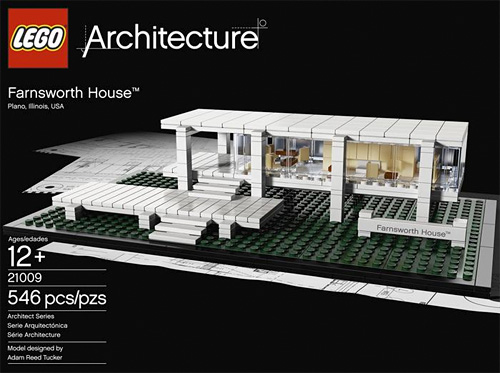
two Lego Sets,
Fallingwater Lego Set. Photo from Lego website.


Farnsworth House Lego Set. Photo from Lego website.

and mold Plywood for an Eames Tree.

Christmas tree made by molding plywood chair legs by Charles and Ray Eames.
Circa 1946. Photo from Library of Congress website.
Read full post »

11.10.2012

Architect Lira Luis to judge international architecture competition during Greenbuild

0 comments
San Francisco, CA - (Nov 10, 2012) - Architect Lira Luis will select the winner for the Generation Kingspan 2012 Student Architectural Competition’s Juried Winner in a 2-stage architecture competition that centers on 3 main criteria: design concept, energy efficiency, and use of sustainable design practices. It is open to architecture students in USA and Canada and consisted of a Popular vote and a Juried Panel vote. This gives entrants two opportunities to win the grand prize. A total of $22,000 in scholarship, cash, software and equipment is at stake including a featured media coverage in Hanley Wood’s Architect magazine, the official magazine of the American Institute of Architects, as well as internship opportunities with architecture firms.

The first stage of the competition (popular vote) started August 1 and continued through November 7. Entries were open to review and voting by the entire public and design community. The winning popular voted entry would be that entry which accrued the most badges. The entries came from leading architecture schools that included Arizona State University, California State University Polytechnic, New Jersey Institute of Technology, University of Minnesota, Ball State University, Savannah College of Art and Design, The University of Texas at Austin, The University of New Mexico, Arch Technical School of New York, University of Oklahoma, Southern Polytechnic State University, Hillsborough Community College, and Darton State College have generated more than a total of 10,500 combined votes.

The second stage of the competition (juried vote) started November 7th and the winner is decided by a panel of expert judges that includes Lira Luis, AIA, RIBA, NCARB, CeM, LEED AP BD+C who was also National Geographic’s 2010 Aspen Environment Forum Scholar.
                                             
The winning designs of the two stages will face-off at the 2012 Greenbuild International Expo in San Francisco, Nov 14-16, 2012 to compete for the title of the overall grand prize winner.                


About Greenbuild
Greenbuild is the world's largest conference and expo dedicated to green building. Thousands of building professionals from all over the world come together at Greenbuild for three days of outstanding educational sessions, renowned speakers, green building tours, special seminars, and networking events.

About Lira Luis, AIA, RIBA, NCARB, CeM, LEED AP BD+C
Lira Luis is a global American architect specializing in organic architecture. She graduated with a Master of Architecture degree from Frank Lloyd Wright’s Taliesin and a Bachelor of Science degree in Architecture, Cum Laude, from the University of Santo Tomas. She holds multiple licenses in Asia, North America, and a Chartered Architect designation in Continental Europe. She has designed an impressive army of diverse and socially-relevant building typographies in Asian and US markets from the small-scale award-winning Portable Transient Shelter Pods to large scale designs for several of the Fortune 100 companies in the US. In 2010, National Geographic and The Aspen Institute selected her as Environment Forum Scholar. In the same year, the American Institute of Architects (AIA) selected her as recipient of the AIA Athena Young Professional Award. In 2011, she represented the A&D community as one of 4 winners in the Reign In Spain Competition by Tile of Spain. She is one of the Midwest’s most innovative design pros who is making a difference in design as named by i4Design Magazine 2011 Suite 16 Top Picks. In 2012, she is named by Engineering News Record as Midwest's Top 20 Under 40. Award-winning architect and design correspondent, Lira contributes articles as a resident blogger in Chicago Tribune’s ChicagoNow,  Benjamin Moore’s Expert Architects. and the AIA KnowledgeNet Blog.

About Kingspan
Kingspan is a global manufacturer of insulated metal panels (IMPs) and other innovative building products, whose growth is leading the way to the future of the building industry. As the largest manufacturer of insulated panels in North America, Kingspan has a long tradition of leadership and innovation, playing a key role in the evolution of the global insulated building envelope industry.
Read full post »

7.28.2012

Architecture Competition for students to create an innovative, Net-Zero Energy, and low-impact environmentally designed building

0 comments
(view original article here)
 
Kingspan Insulated Panels North America, a global manufacturer of insulated metal panels for building construction, announced today the launch of Generation Kingspan™, a contest for architecture students. The contest encourages U.S. and Canadian students to create an innovative, Net-Zero Energy, and low-impact environmentally designed building using Kingspan’s Insulated Metal Panels (IMPs) and reflecting Kingspan’s sustainable corporate philosophy.

The contest starts August 1, 2012, and will culminate with a Grand Prize winner selection in November at the Greenbuild 2012 International Conference and Exposition in San Francisco. The competition merges the benefits of a juried expert panel review with the wisdom of the crowd -- with one winner determined by the judging panel and another winner determined by voting on the Generation Kingspan on-line design community. Both winners will receive an internship at an architecture firm, a $2,500 scholarship and a $1,000 cash prize. The top designs will then compete for exhibit floor votes at Greenbuild to determine the grand prize winner, who will be awarded a laptop and voucher for design software.

The Crowd-Vote Contest. All submissions will be reviewed first by online voters visiting and participating on the contest website. Online reviewers will have the ability to assign badges to designs based on the three key elements of the design competition: 1. Design/Vision, 2. Sustainability, and 3. Energy Efficiency. In addition, commenting capabilities will enable students, expert voters and entrants to discuss the designs for crowd-sourced learning opportunities. The on-line community winner will be based on the design that accumulates the most badges.

The Juried Contest. Complementing the above, the contest also supports a winner, reviewed by an expert jury. The 2012 jury includes:
  • Lira Luis, AIA, RIBA, NCARB, LEED AP BD+C, Principal Architect Role at ALLL (Atelier Lira Luis, LLC) a MBE certified firm
  • Chris Mundell, AIA, CSI, CDT, LEED AP BD+C, Vice President/Sustainable Design Coordinator at HKS
  • Mark Roddy, Design Principal at Smith Group
  • Keith Spurlin, CSI, CDT, Associate AIA, Business Development Manager, Kingspan Insulated Panels NA, Inc., former project designer, Gresham, Smith and Partners.
  • Paciano Diaz, RA, MBA, LEED AP, Business Development Manager, Kingspan Insulated Panels NA, Inc., former Senior Project Manager, Westfield Corp.
  • Harvey Bryan, Ph.D., FAIA, LEED AP, Professor and Senior Sustainability Scientist at the Global Institute of Sustainability at Arizona State University
“The next generation of architects are digital natives, socially interactive by nature,” said Andrea Peters, Director of Marketing for Kingspan Insulated Panels North America. She explained, “We believe the peer commenting within our design competition will be as valuable to them as the juried contest. It’s not just about identifying exemplary design from one winner, but fostering wider discussion of sustainable and energy efficient design among all participants, design students and experts alike.”

Submissions for Generation Kingspan must be received by October 31, 2012. To learn more about the competition, register online and download materials, visit http://www.generationkingspan.com.


About Kingspan Insulated Panels North America
Based in Deland, Fla., Kingspan Insulated Panels North America is a global leader in insulated metal panels (IMPs) manufacturing, serving U.S., Canadian and export markets. Kingspan IMPs are manufactured as a single component system with high R-value, unsurpassed airtightness and superior moisture control suitable for new and existing buildings. As the most energy-efficient, cost-effective building envelope solutions, IMPs are at the forefront of sustainability. Kingspan IMPs are a significant first step to achieving net-zero energy building and consistently contribute to U.S. Green Building Council (USGBC) Leadership in Energy and Environmental Design (LEED®) credits and certifications. Kingspan IMPs serve the architectural, commercial/industrial, cold storage and food processing markets, and is committed to delivering the most advanced building products on the market. Visit http://www.kingspanpanels.us and http://www.kingspanpanels.ca for details.
Read full post »

5.18.2012

In Full Light

0 comments

(A guest blog post recapping some of the events surrounding the recent Lightfair International conference, covered by Enrique Otarola. Lightfair is north America's largest annual architectural and commercial trade lighting show. View original article here.)


I haven’t been in Las Vegas – Nevada for the past 4 years, and I wanted to see the new places and buildings in sin city. Another big reason to visit Las Vegas was to meet Lira Luis, a celebrity architect speaker that I admire and I had followed for years with the use of social media.
We (Me, Robert, and Christopher) planned this trip for a few weeks, so we headed to Las Vegas for some distraction, excitement and fun.
In Day one, we arrived in the early afternoon and checked in at the hotel. This hotel has a theme for movies and entertainment in each room. There were no lines and the crew was so nice and helpful at all times. Almost immediately we headed to a restaurant in the famous strip. The desert heat was present at 94 degrees around 7 pm.
Las Vegas strip
After a fun dinner we decided to go across the street to see the new Las Vegas center. It was unbelievable to see how the designers came up with an idea to build a three story floor chandelier bar, the crystals hang from the roof (of the third floor roof) all the way to the first floor, literally; all of this inside a building.
Having a degree in Civil Engineering (for almost 20 years), it amazes me how these designers and builders came up with this concept. I recall in my early Engineering years (yes, many of you weren’t even born yet) how difficult it was to build these funky designed buildings that my early employers want me to build. I remember back in my early 20’s, just fresh out of engineering school, and having been a resident engineer at this apartment complex construction site, how challenging it was to build the entrance for the complex that had a particular design. I was just wondering about all the challenges (it took) to build these amazing structures. I give all my respect to whoever built this structure.
Let’s keep in mind that Las Vegas, a city that was designed to be enjoyed at night, and having said that, its structures and buildings were intended to be enjoyed in the dark, a good lighting system must be in place. So attending the Lightfair International 2012 that was held at the Las Vegas Convention Center would be a great idea.
There is a restaurant bar inside
After a long walk inside this new center I was ready to continue with the fun “Las Vegas style” across the street, so we headed to another place. And after visiting 3 more places and just having a few more hours before my work on the second day started, we headed to the hotel.
Day two: I was worried of not having enough sleep before my working day, but I was energized and ready at 8 am, so I got ready and headed to the Lightfair International 2012 conference.
I was nervous and excited at the same time, not every day do you have the chance to be invited as a Blogger press to cover an important event, but also this was the first time that I will meet Lira Luis and to attend one of her speaking events.
Lira Luis and Enrique Otarola
I’ve been working in the blogging world, networking, and interacting with people using the social media tools for a few years now. Trust me when I say it’s not easy. You have deadlines. You have people to see, places to go, and business to do. In a way you are in people’s radar all the time, so you have to develop a thick skin some times because not everybody likes what you do (or your opinions). You get lovers and haters too.
So meeting Lira Luis was a big deal for me because she is doing the same thing (as me) and much more but in a mega level. Lira travels all over the country. She has architectural licenses in Arizona, Wisconsin, and Asia. She speaks at different events throughout the year all over the globe.
I arrived at the Lightfair event in the morning and picked up my press credentials and immediately headed to the auditorium to cover Lira’s presentation. Me and my 30 pound press equipment went straight to N116 where Lira will be.
When I entered the room, the moment was magical for me; I’ve seen the room full of people, all of them ready for Lira’s presentation. I looked for the best place to see the presentation and I quickly found it. I unloaded all of my press “cargo” (professional camera, video camera, tripod, PC laptop, digital recording, etc.) and then, I was ready. In moments like these, I wondered “Where is my assistant? He is sleeping off the party time from last night.”
Then, there she was, we had a good distance between each other but she managed to recognize me among all of the attendees and then she waved her hand hello to me.
Lira Luis at LFI in Las Vegas
Lira spoke about the concept of “opportunities to define space with light”, which I found so interesting. All the buildings and structures become pleasant to the human eye when they are in display to be enjoyed.
Having an engineering chip deep in my brain, at the beginning I couldn’t quite understand it, so having all of these wonderful pictures in a presentation called Prezi, were so helpful, even to an engineer.
Lira showed pictures of spaces that were enhanced by the natural light at different times of the day, for instance, Lira showed a picture of a shelter (living space) that she lived in while attending her architecture school.
It was amazing for me that Lira was just talking about the same concept that I had in mind just hours ago about a city, places to be admired at night. Although this concept was more organic, the principle was the same.
In a more specific part of the presentation, Lira presented “pockets of opportunities to define space with light”. I liked the picture of a brick wall that was brought to life with the simple fact of having a light entrance in the right place (for the different hours) bringing different effects throughout the day.
Lira Luis presentation
After the hour and a half of presentation, I learned something else about architecture. How important it is to keep the original design of a building. Sometimes the design suffers due to the changes in budget and time of the construction process.
After the presentation was over, I went to the press room to immediately start working on this new material, and while waiting for Lira I had the chance to meet Brandon Smith a designer based in San Diego and a power blogger. We enjoyed a fun chat while having a bite. You can read more about Brandon Smith at http://dcoopsd.wordpress.com/
..
Enrique and Brandon
I’ve also had the chance to meet another press colleague Merwin Videña, who was covering this Lightfair international event from San Diego.
Then, after Lira was finally free (she is a busy professional) I kidnapped Lira in our media booth at the Press room, where we talked more in detail about her presentation and I also had the chance to shoot a short interview for everybody to enjoy.
After having the opportunity to meet Lira and learning first hand about her amazing work, I can’t just get enough of this amazing woman, so we planned to have dinner at the hotel, later the same day.


Click here to watch full video interview
 
The event was full of people from all over the world, interesting vendors and imaginative creations too. You can see more about this event at – http://www.lightfair.com/


Enrique Otarola, a civil engineer by training, is also an entrepreneur in different fields. His blog Finding the right Tax Accountant journey encourages individuals to find their passion in life and follow it. It is read by thousands.


Read full post »

5.02.2012

Lightfair International 2012 Design Symposia Feature Architects, Designers And Innovators

0 comments
By Mel Fabrikant of Paramus Post (read original article here)

The Design Symposia at LIGHTFAIR® International (LFI), the world’s largest annual architectural and commercial lighting trade show and conference, each offer 90 minutes of knowledge from the design community’s leading experts. The Design Symposia create a global stage for architects, designers and innovators to share their work and their vision. The trade show opens Wednesday, May 9, 2012 at the Las Vegas Convention Center in Las Vegas and the Design Symposia take place on Thursday, May 10, 2012.

2012 Design Symposia include:
• Healthcare Lighting: Cleveland Clinic Case Study (8:30am-10:00am) – John D'Angelo, PE, CMVP, Senior Director of Facilities, Cleveland Clinic
Principally through lighting conversion projects, Cleveland Clinic has achieved a 20% reduction in energy usage over the last four years while improving patient outcomes, patient safety and patient experience.
• Light Spaces Wright Places (10:30am-12:00pm) – Lira Luis, AIA, RIBA, LEED AP BD+C, Principal Architect, atelier lira luis, LLC
Frank Lloyd Wright's Taliesin became an illustration of daylighting strategies. Luis discusses her experience living at one of America's architectural landmarks and how this demonstrates the value of defining architectural spaces with light.
• Creating Choreographed Experiences: A Sensory Exploration of Interiors (2:00pm-3:30pm) – Zia Hansen, AIA, NCARB, Associate Senior Designer, Wimberly Interiors (WATG)
Great design explores, investigates and exploits the power and magic of light and spatial volume to create daring, seductive and enhancing experiences. A designer’s goal is to exploit the characteristics of the space, location and theme being evoked.
• Lighting in Hospitality Interior Design (4:30pm-6:00pm) – Gerry Jue, AIA, Principal, BAMO
This course will be an overview of hospitality lighting design from the interior designer's perspective, using images and documentation from completed and current BAMO work. Topics include: hospitality lighting design concepts and strategies; working with a hospitality lighting designer; custom fixture design and documentation.

The four featured Design Symposia will be held in conjunction with the LFI 2012 Conference program and will take place on Thursday, May 10. Attendees are required to pre-register for the sessions. More information on the Design Symposia, and the entire lineup of Conference seminars and Institute courses, can be found online at http://www.lightfair.com/lightfair/V40/index.cvn?id=10266

The LIGHTFAIR Daylighting Institute® and the LIGHTFAIR Institute® take place as part of the Pre-Conference program on Monday, May 7 – Tuesday, May 8, 2012 and the LFI Trade Show and Conference will run Wednesday, May 9 – Friday, May 11, 2012. For more information about LIGHTFAIR International, please visit www.lightfair.com . Download the LFI Mobile App at m.lightfair.com.

LIGHTFAIR International is the world’s largest annual commercial and architectural lighting trade show and conference and is sponsored by the International Association of Lighting Designers (IALD) and the Illuminating Engineering Society (IES). The event is produced and managed by AMC, Inc.
Read full post »

2.16.2011

Reign in Spain: A Breath of Fresh Tile Selections at Cevisama

1 comments
During the 2011 Cevisama, the International Ceramic Tile and Bath Furnishings Show in Valencia, Spain, I was enlightened to a breadth of options that tile products now provide to our industry. One of the products that caught my architectural eye is a ventilated facade system that utilizes ceramic and porcelain tile for cladding. It brought back memories of driving in Arizona and seeing this product used at the Wilkinson Floor Covering Corporate Office & Warehouse in Tempe, designed by Michael P. Johnson...

>> Continue at TalkContract.com
Read full post »

2.09.2011

Reign in Spain: I Tripped, I Saw, I Appreciated

0 comments
The Reign In Spain A&D Tour kicked off in Zaragoza, Spain, famous for its folklore, gastronomy, and architecture. And I got to know the Old Town Zaragoza and its history up close and personal—I tripped over a crater while walking on the cobblestone streets as I looked up and admired the Baroque architecture of Nuestra Senora del Pilar Basilica and the Gothic-Mudéjar architecture of La Seo Cathedral. This was as close as I could get to viewing and analyzing the cobblestone paving material that was ubiquitous in Zaragoza. I remembered that particular street was laid out in a running, bond paving pattern.

Read more>>>
Read full post »

1.27.2011

A Tribute To Taliesin's 100 Years

0 comments
As Taliesin celebrates 100 years since its construction, I look back at my own memories of what it was like when I first set foot at this historic landmark considered one of the best examples of Organic Architecture. Frank Lloyd Wright encouraged the apprentices at Taliesin to tap into creative writing way before blogging ever existed, as part of a multi-faceted architecture experience. This was yet another exercise of Frank Lloyd Wright's vision that was so ahead of his time. This article was one of the first pieces I wrote shortly after arriving at Taliesin in Spring Green. It is taken from the Wisconsin River Valley Journal, September/October 1997 Vol 5, Issue 2:
Between 1934-37 the Wisconsin architect Frank Lloyd Wright and his Taliesin apprentices wrote columns printed in Wisconsin newspapers. Wisconsin River Valley Journal continues the tradition. This issue's contribution is by Anna Lira V Luis, a Taliesin apprentice from the Philippines. She is pursuing her master's degree from the Frank Lloyd Wright School of Architecture.             - Wisconsin River Valley Journal
More. To read the columns of 1934-37, see "At Taliesin," Newspaper Columns by Frank Lloyd Wright and the Taliesin Fellowship. Southern Illinois University Press, 1992. - Wisconsin River Valley Journal

Taliesin Break Away

A few months back, I decided to break away from a very typical architectural lifestyle. Being a practicing architect from the Philippines, I would go through the normal routines of the profession---designing, revising, designing, revising, and doing more designing and revising! I guess no matter what part of the globe an architect practices, these are inevitable aspects of the profession. The more I get involved with architecture, the more I want to comprehend its complex nature. With this yearning, I packed my bags, gathered my guts, and flew willfully to Taliesin to satisfy my thirst for architectural knowledge.

Although much of Taliesin was in deep slumber when I made my entry, I was greeted by the stunning Hillside studio. I could not believe that I was actually inside this picture perfect structure that I had only seen in pictures! I remember vividly that sleepless first night at the "shining brow". I had mixed emotions. I was excited with what the next day would bring. At the same time, I was concerned with what I could make of it.

The very first morning, I decided to explore the magical mystery of the school. Possessing a very academic background, I started to look for my classroom---just as a normal graduate student would on the first day of classes. There was none. Yes, there are no classrooms, because every corner of Taliesin is a classroom! Learning is achieved by experience. The concept of "learning by doing" is so foreign to me that it sparked my interest. I have wanted to break away from the confines of a four-walled classroom, and take a more revolutionary way of learning. It is because my academic background has trained me well enough to be a good student that I now want to know the meaning of apprenticeship. The challenge is how to apply the theoretical knowledge in actual practice and learn from it. I realized that even a very mundane tast such as scraping paint off the ceilings can become a source of information. It is during these times that I have the opportunity to view ceiling and roof connections that would be helpful in drawing details of these. It becomes much easier to draw something that is familiar just because one has seen it before.

There is so much to learn not only about the buildings in Taliesin but also the environment. It is amazing to realize that even the trees and sparrows relay knowledge and inspiration. The community setting supplements the learning process of apprentices. Activities are geared towards their relation to architecture. As a result, Taliesin-trained architects become equipped with a more well-rounded architectural sense. The place is a haven for artists desiring to have architecture as a means of expression. Never in my academic training have I experienced architecture in its purest intensity, the way Taliesin has let me. No other place educates the way Taliesin educates.

The knowledge I absorb is worth the thousands of kilometers I traveled to acquire it. I am being molded to become an architect armed not only with theoretical knowledge but also practical training. When the time comes for me to leave the place, I would know that every minute spent in Frank Lloyd Wright's "organic classroom" would remain with me. A part of me has become a part of Taliesin, and a part of Taliesin has become a part of me.

Mr. Wright may no longer be around physically, but his creative spirit is very much present today as it was during his lifetime. His contribution to architectural education by way of Taliesin will continue as long as nature continues to educate. Taliesin breaks away from the classroom just as Mr. Wright broke away from the box. 

About Taliesin

Taliesin is the home of the Taliesin Fellowship, a group of architects, artists, educators and architects-in-training continuing the work and learning program begun by Mr. and Mrs. Frank Lloyd Wright at their home and school buildings near the Wisconsin River near Spring Green. The buildings and the 600-acre campus they are located on are known together as Taliesin. The name is Welsh and literally means "shining brow." - Wisconsin River Valley Journal
Read full post »

Popular Posts


Creative Commons License
Architecture Meets Life by Atelier Lira Luis, LLC (ALLL) is licensed under a Creative Commons Attribution 3.0 Unported License.
Based on a work at http://www.liraluis.com.

Copyright © Architecture Meets Life Design by Free CSS Templates | Blogger Theme by BTDesigner | Powered by Blogger